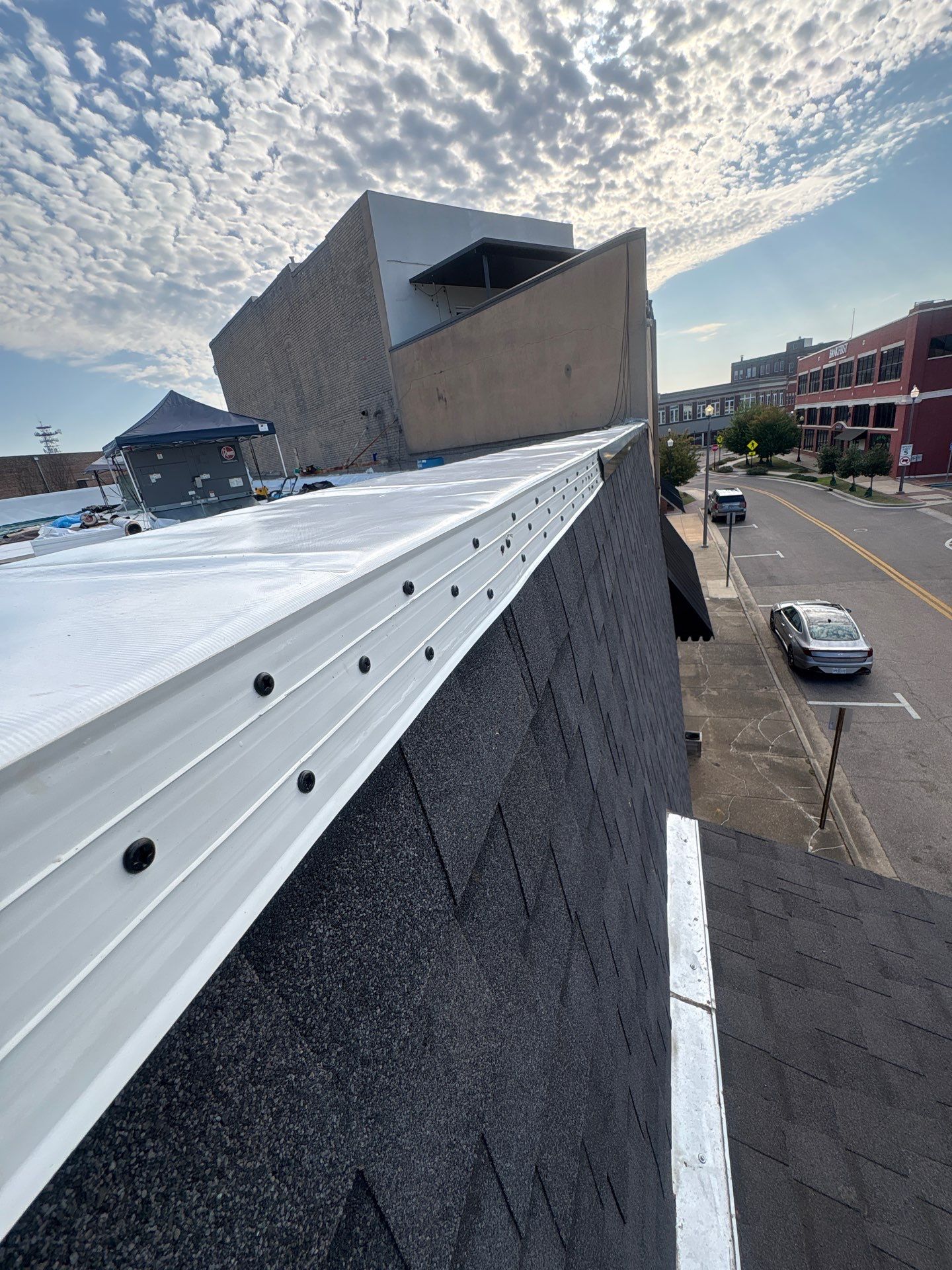
Choosing a commercial roofing system is a significant decision. Your roof must protect your building, inventory, employees, customers, and daily operations—all while standing up to Mississippi’s heat, humidity, heavy rain, and severe weather.
TPO and PVC are two popular single-ply membrane systems used on commercial and low-slope roofs. Although they may look similar from the ground, their composition, performance characteristics, and ideal applications are not identical.
So, how do you decide between TPO and PVC roofing?
The right answer depends on your building, its daily operations, the condition of the existing roof, and the environmental conditions the roof must withstand. Cox Roofing installs and services commercial roofing systems throughout Mississippi and can help you determine which option provides the right protection for your property.
TPO stands for thermoplastic polyolefin. It is a flexible, single-ply roofing membrane commonly installed on flat and low-slope commercial roofs.
TPO roofing typically consists of a reinforced membrane installed over insulation and an appropriate roof deck or cover board. During installation, adjoining sections of the membrane are joined using hot-air-welded seams. When properly installed, these welded seams help create a continuous, water-resistant roofing surface.
TPO membranes are commonly available in light, reflective colors. According to the U.S. Department of Energy, reflective roofs can remain cooler than conventional roofs under the same sunny conditions. Actual energy performance will depend on the complete roof assembly, insulation, building design, climate, and HVAC system.
TPO is frequently considered for:
PVC stands for polyvinyl chloride. Like TPO, PVC is a flexible, single-ply roofing membrane with seams that are typically joined through hot-air welding.
PVC roofing has a long history in commercial applications. Depending on the particular product and assembly, it may offer strong resistance to moisture, UV exposure, grease, oils, and certain chemicals. This can make PVC worth considering for buildings where roof surfaces may be exposed to contaminants from vents or commercial operations.
Common PVC roofing applications include:
Cox Roofing works with commercial roofing products from manufacturers such as Duro-Last, which offers PVC, KEE-modified PVC, and TPO membrane options for different commercial applications.
| Factor | TPO Roofing | PVC Roofing |
| Material | Thermoplastic polyolefin | Polyvinyl chloride |
| Typical roof type | Flat and low-slope roofs | Flat and low-slope roofs |
| Seam construction | Hot-air welded | Hot-air welded |
| Reflective options | Yes | Yes |
| Chemical and grease resistance | Varies by product | Often selected when enhanced chemical or grease resistance is needed |
| Common applications | Offices, retail, warehouses and general commercial properties | Restaurants, manufacturing and buildings with rooftop exhaust |
| Installation | Requires trained professional installation | Requires trained professional installation |
| Best choice | Depends on the building and approved assembly | Depends on the building and approved assembly |
These are general comparisons. Membrane thickness, reinforcement, attachment method, insulation, cover board, drainage, flashing details, warranty requirements, and manufacturer specifications can all affect performance.
Mississippi commercial roofs face intense sunlight, high humidity, heavy rainfall, wind, and sudden severe storms. Both TPO and PVC can be used successfully in this climate when the complete roofing system is properly selected and installed.
A commercial roof may be exposed to direct sunlight for most of the day. Light-colored TPO and PVC membranes can reflect a portion of the sun’s energy instead of absorbing as much heat as a darker surface.
However, a reflective membrane alone does not determine the building’s energy efficiency. Insulation levels, air leakage, rooftop equipment, building use, and the condition of the HVAC system also matter.
Both membrane systems are designed to create a water-resistant surface, but even a quality membrane cannot correct every drainage problem.
Commercial roofs should direct water toward appropriately designed drains, scuppers, or gutters. Ponding water may indicate clogged drains, improper slope, compressed insulation, structural movement, or another underlying issue. Proper drainage is critical to the roof’s long-term performance.
If your commercial roof holds water after storms, schedule a professional roof inspection rather than waiting for interior leaks to appear.
Commercial roofs in Mississippi must also be designed with wind exposure in mind. The deck, insulation, attachment method, perimeter details, penetrations, edge metal, and membrane all work together as a system.
The correct design depends on the building’s height, location, roof deck, surrounding terrain, applicable building codes, and manufacturer requirements. Selecting a membrane based only on its name or price overlooks many of the components that determine wind performance.
TPO may be an appropriate choice when a business needs a reflective, flexible membrane for a general commercial application.
It may be considered for:
TPO has become a widely used commercial roofing material, but not all products and assemblies are the same. Membrane thickness, reinforcement, installation method, manufacturer, and warranty coverage should all be evaluated before making a decision.
PVC may be the better candidate when the building’s operations create potential exposure to grease, oils, chemicals, or other contaminants.
For example, restaurant roofs frequently contain exhaust vents that can release grease and other substances onto the surrounding membrane. Certain manufacturing and industrial facilities may present similar concerns. A membrane designed for the expected exposure can help protect the roof from premature deterioration.
Some PVC systems are also designed for roofs that frequently encounter wet conditions. Duro-Last states that its PVC roofing membranes provide UV resistance and can withstand ponding water and persistently damp conditions. Product selection and warranty requirements should still be reviewed for each project.
PVC may be considered for:
The exact type and concentration of any chemical exposure should be discussed with the roofing contractor and membrane manufacturer before a system is selected.
PVC roofing often carries a higher initial material cost than some TPO options, but price should not be the only factor in the decision.
The total cost of a commercial roofing project can be affected by:
Choosing a less expensive membrane that is poorly suited to the building’s operations could lead to additional repairs or an earlier replacement. Conversely, a more expensive product is not automatically necessary for every property.
A professional evaluation allows the roofing contractor to recommend a complete system based on the building rather than making a decision based solely on price per square foot.
Not every leak means the entire roof needs replacement. Depending on the membrane’s age and condition, isolated damage may be repairable.
A commercial roof repair may be appropriate when:
A commercial roof replacement may be recommended when:
The condition beneath the visible membrane matters. A professional inspection may include evaluating seams, flashing, penetrations, drainage areas, insulation, and accessible portions of the roof deck.
TPO and PVC are both capable commercial roofing materials, but even a high-quality membrane can underperform if it is installed incorrectly.
Many commercial roof leaks begin around:
These areas require careful preparation and flashing. The membrane must also be installed using an attachment method that is appropriate for the building and the manufacturer’s approved assembly.
Professional installation helps ensure the roof is constructed as a complete system and that applicable warranty requirements are followed.
Before selecting a membrane, ask your commercial roofing contractor:
The answers should be specific to your building. A roofing recommendation should consider how the property is built and used—not just its square footage.
There is no universal winner in the TPO-versus-PVC comparison.
TPO may be a practical choice for many offices, stores, warehouses, churches, and general commercial buildings. PVC may offer advantages for restaurants, manufacturing facilities, and properties where enhanced grease or chemical resistance is important.
The right system depends on:
That is why a professional roof evaluation should come before the final material decision.
Cox Roofing provides professional commercial roofing services for businesses in Laurel and communities throughout Central and South Mississippi. Our team can inspect your roof, identify areas of concern, and explain whether repair, replacement, TPO, PVC, or another roofing solution is appropriate.
Protect your building before a small roofing issue interrupts your business. Call Cox Roofing at 601-319-7857 or schedule a free estimate today.